Quick summary
- Ranking #1 on Google doesn't mean you're the first thing a searcher sees anymore. Ads, Maps, and AI Overviews now occupy most of the visible page.
- Zero-click searches, AI Overviews, and voice assistants are pulling an increasing share of local intent away from the classic ranked list.
- AI answer engines don't re-run Google's ranking algorithm. They surface businesses based on review signal, GBP completeness, and citations, not organic position.
- What still moves leads and phone calls: phone answer rate, a complete Google Business Profile, Local Service Ads, transparent pricing, and presence across Apple, Yelp, and Bing. Not chasing another rank position.
If you're a home service business owner, you've been probably told the same story for a decade: get to position #1 on Google, and the phone blows up every single day. For decades, that was true... but not anymore.
Don't worry, SEO has not stopped working and can still bring you so much business if you do it right. But things are changing fast after AI came into the picture. Google "Position #1" stopped meaning "the first thing anyone sees." In 2026, the businesses winning local leads and phone calls aren't the ones fixated on a blue link's rank order. They're the ones who understand what's actually happening on the page above it, and who's making the recommendation before the user ever scrolls.
Here's the data, and what it means if you run (or market) a plumbing, HVAC, electrical, roofing, or pest control company.
The big picture: search itself is shrinking
Before we even talk about ranking, there's a simpler problem. Fewer people are searching on Google at all.
According to Gartner's 2026 search forecast, traditional search engine volume will drop 25% as AI chatbots and virtual agents take over queries, and that's roughly the world we're living in. Users aren't typing queries into Google the same way. They're asking ChatGPT, Perplexity, Siri, and Gemini. They're searching on TikTok and Reddit. They're getting answers without ever opening a browser.
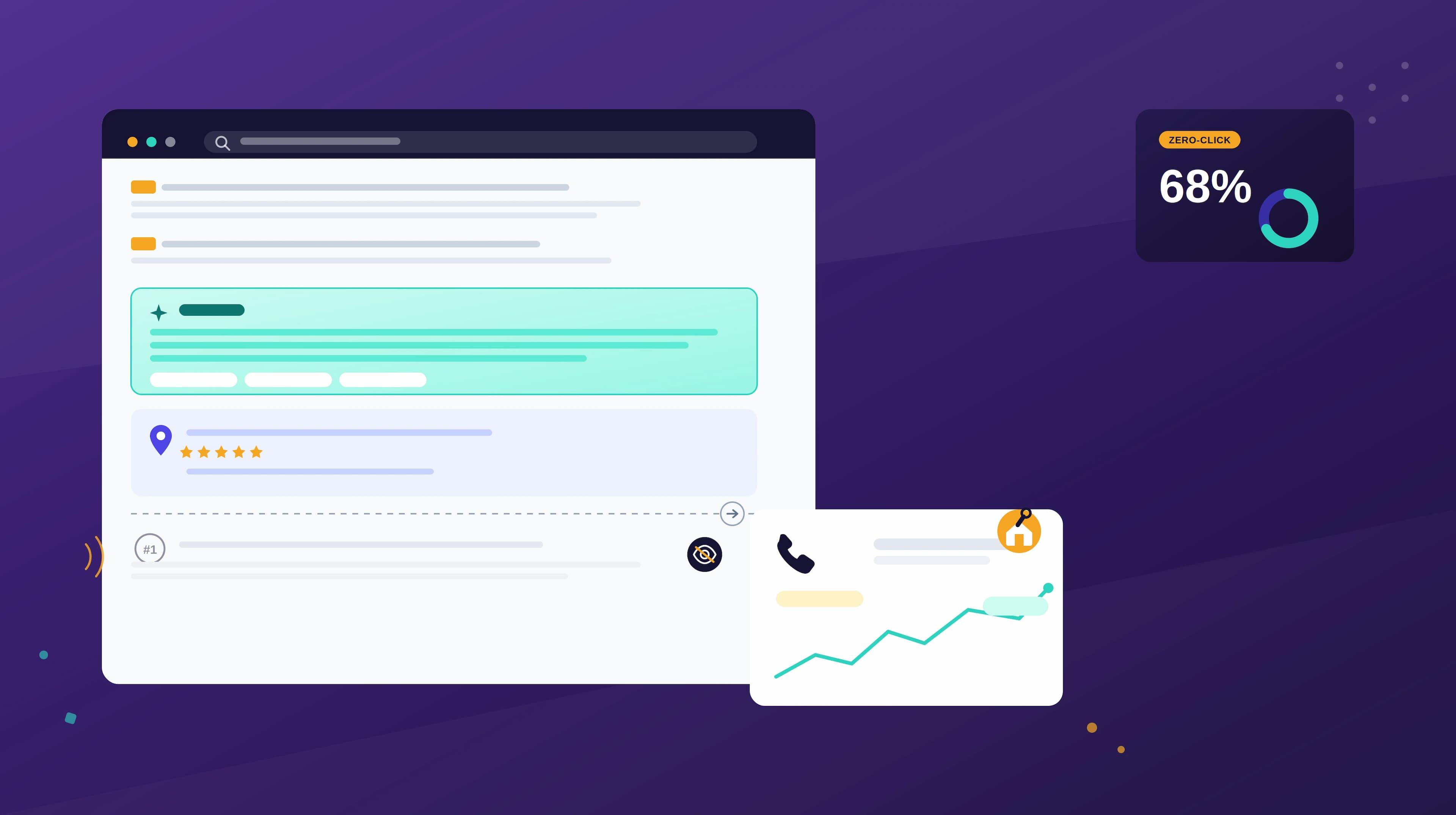
On the searches that do still happen on Google, zero-click searches now account for roughly 68% of all queries, up from about 60% just two years ago, according to SparkToro's 2026 data. The user gets their answer, a phone number, a star rating, an address, directly on the search results page. They never click through to a website.
So you're competing on a smaller playing field, and even when you're on it, most people never click.
Position #1 is often invisible
The core assumption behind "just get to #1" was always that #1 equals first thing seen equals most clicks. That assumption depended on the SERP looking roughly the way it did in 2015: ten blue links, maybe a map pack, done.
It doesn't look like that anymore. A recent pixel-based analysis of the modern SERP by Tom Capper of STAT Search Analytics, covered by Search Engine Journal, found:
- The #1 organic result sits ~635 pixels down the page on desktop, against an average viewport of roughly 800px. Only 57% of #1 results appear above the fold on desktop at all.
- On mobile, it's worse: just 40% of #1 organic results are above the fold. Most people scroll past ads, Maps, and AI content before they even reach the "top" result.
- On commercial and local-intent queries, the kind home service businesses actually compete on, paid ads and Local Service Ads eat over 60% of the above-the-fold space, sometimes more than 66%. Organic results are squeezed into roughly 16% of the visible page.
- A #3 result with rich snippets (photos, star ratings, price) can physically occupy double the pixel space of a plain #1 listing (~240px vs ~120px). It wins more attention despite ranking lower.
Rank order is still a real signal that carries weight. It's just no longer a reliable proxy for visibility, and visibility is what actually generates a click or a call.
AI Overviews are now the first thing people see, and they don't cite by rank
The bigger shift is what's sitting above organic results in the first place: AI-generated answers.
- AI Overviews now appear on 68% of local searches, while the traditional local pack (the 3-pack map listing) shows up on only 39% of those same queries. That's a reversal of the old hierarchy where the map pack was the default local SERP feature, according to a Whitespark case study spanning 3 cities, 6 industries, and 540 queries.
- Being ranked #1 organically doesn't guarantee an AI engine mentions you. Local Falcon's 2026 restaurant study found 83% of restaurants never appear in ChatGPT's recommendations at all. Only 17% show up in any AI answer, regardless of how they rank on Google.
- According to an Ahrefs study of 300,000 keywords, AI Overviews correlate with a 34.5% reduction in click-through rate for the page ranking #1 underneath them, comparing the same keywords before and after an AI Overview appeared.
- The upside: according to Seer Interactive, brands cited inside an AI Overview see roughly 35% higher organic CTR than uncited competitors ranking on the exact same query. Being mentioned matters more than being ranked.
AI isn't re-running the ranking algorithm. It's mimicking the preference journey of real users. Google's classic ranking is still largely link-and-relevance based, positional logic. AI Overviews and AI answer engines reflect behavioral signal: what people actually read, trust, quote, and act on across a whole research journey. A business with strong reviews, consistent citations, and content that other sites and users reference gets surfaced regardless of its organic rank, because that's the pattern AI is mimicking: not ranking pages, but tallying up which business keeps showing up as trustworthy across reviews, citations, and mentions — the way a person would if they were researching by hand.
That reframes the whole game. You're no longer optimizing to win a slot. You're optimizing to be the answer a system built on collective user behavior decides to repeat.
Voice search is the part most home service businesses are missing
There's one channel growing faster than traditional search that gets almost no attention in most SEO advice: voice search.
- Juniper Research found 8.4 billion voice assistant devices already in use globally as of 2024, more than one per person in most developed markets.
- Voice search is now a routine habit for a large share of consumers. Commonly cited estimates put regular use at roughly 40-45% of U.S. adults.
- In one of the most widely-cited industry surveys, 58% of consumers said they'd used voice search to find local business information, a behavior BrightLocal research confirms has only grown since. It's higher still for urgent home service needs.
- "Emergency plumber near me" and "AC repair near me" are textbook voice queries.
Here's the problem most businesses don't realize: voice assistants almost never read from organic position #1. They pull from the featured snippet (position zero), the Google Business Profile (hours, phone, reviews, "open now" status), or the local pack.
When someone says "Hey Siri, find a plumber open now near me," Siri doesn't care who ranks #1 in organic search. It reads from the GBP with the best combination of proximity, hours, and review score, pulled through Apple Maps and Yelp data, not Google's organic index.
A business that ranks #1 organically but has thin GBP data, inconsistent hours on Apple Maps, and no Yelp presence is invisible to voice search, which is exactly where a growing share of local queries are happening.
We tested it ourselves: there is no static #1 anymore
Everything above is third-party data. Here's what we found running our own test.
We ran a series of the same (or closely related) local service searches through ChatGPT across multiple sessions and user framings. The result: eight different companies surfaced as the "#1" recommendation, not one. There was no single stable answer to "who's the best [service] company." The answer moved depending on what the model inferred the user actually wanted.
That instability is the point, and it's easy to miss if you're still thinking in terms of a ranked list. Classic Google SEO produces one ordered result set for a given query, the same #1 for everyone searching the same term in the same city, modulo minor personalization. An AI answer engine doesn't work that way. It's running something closer to a live match against inferred intent each time: is this person price-sensitive or quality-sensitive? Are they looking for a local independent operator, or comfortable with a national brand? Do they want the fastest available appointment, or the most reviewed company? Change the implied answer to any of those questions, even without changing the literal query, and the "#1" recommendation changes with it.
And it's not just ChatGPT. The AI search landscape is fragmented across multiple platforms, and each one pulls from different data sources:
| AI Platform | Primary Data Source | What It Rewards |
|---|---|---|
| Google AI Overviews / Gemini | Google Knowledge Graph + GBP + web crawl | GBP completeness, schema, structured content |
| ChatGPT Search | Bing index + web crawl + citations | High-authority backlinks, cited by third-party sources |
| Perplexity | Real-time web + cited sources | Being mentioned on authoritative editorial sites |
| Apple Intelligence / Siri | Apple Maps + Yelp + structured web | Apple Business Connect, Yelp profile, schema markup |
| Microsoft Copilot | Bing index | Bing Places, GBP sync, structured data |
A business optimized only for Google's ecosystem could be completely invisible in Apple Intelligence or Perplexity, and vice versa. There's no single "win" anymore.
That confirms the framing: the AI isn't re-running Google's ranking algorithm, it's mimicking a user preference journey. "Position #1" implies a fixed leaderboard. What we saw looks more like real-time intent-matching against a pool of eligible companies, closer to how a good salesperson reads a customer than how a search index sorts URLs. For a home service business, that means there's no single listing to "win." There are several possible personas an AI might be matching a searcher against, and you either have the signal to win each of them (visible pricing for the cheap-and-fast persona, review depth and certifications for the quality persona, service-area specificity for the local persona, brand recognition for the national-comparison persona), or you're invisible to that slice of demand regardless of your Google rank.
Why this matters even more for local, home-service searches
General SEO commentary tends to talk in the abstract. For home services, the local layer makes this concrete, because local search has always had more "real estate" competing for the same screen than a generic informational query.
- According to Backlinko's user behavior study, the local 3-pack still gets roughly 42% of clicks on local searches, more than any single organic listing.
- Google Business Profile signals account for roughly 32% of local pack ranking weight, per Whitespark's ranking factors report, a bigger single lever than most on-page or backlink factors combined.
- According to Think with Google, 76% of people who do a local mobile search visit a related business within 24 hours, and nearly 3 in 4 of those visits lead to a purchase or contact the same day.
- Missed calls are one of the biggest silent lead leaks in home services. Most callers simply move to the next result rather than calling back, according to CallRail.
- GBP optimization shows measurable results in 60-90 days. Full organic SEO typically takes 6-12 months to move the needle.
In other words: for a plumber or HVAC contractor, the "SERP" a customer sees is dominated by paid ads, the map pack, AI Overviews, and rich review snippets, long before they hit a ranked organic result. And the customer isn't reading ten blue links and comparing domain authority. They're scanning for "open now," "4.8 stars, 340 reviews," "same-day service," and a number they can tap. Position on the organic list is almost a footnote to that decision.
What this looks like for real home service businesses
HVAC company: ranked #1, leads and calls flat
Their target keyword, "AC repair [city]," is a high-commercial-intent query. Above their #1 organic listing sits three Local Service Ads, an AI Overview summarizing "how to choose an AC repair company," and the 3-pack. Their actual organic listing is the fifth thing on the page and below the fold on mobile. Ranking #1 organically got them nothing, because "organic #1" was never competing on a level playing field with paid results and Maps.
Fix: redirect budget and effort into Local Service Ads (Google-guaranteed badge) and GBP review velocity. Those are what's actually occupying the visible page.
Plumber: ranked #4, dominates leads and calls
Their GBP has 380+ reviews at 4.9 stars, complete service categories, weekly photo uploads, and Q&A answered same-day. They show up in the local pack every time, and their review snippet takes up more visible pixels than the two organic listings above them. They're also the business an AI Overview cites when it answers "best emergency plumber in [city]," not because of backlinks, but because review sentiment and consistency are the behavioral signal the AI is mimicking.
Rank position was irrelevant to their lead and call volume. GBP completeness and review signal did the work.
Roofer: wins pixels, not position
Ranked #3, but added FAQ schema, review schema, and project-image schema to their service pages. Their listing now renders with a star rating, photo carousel, and price range, roughly double the pixel footprint of the plain #1 listing above them. Click share shifted toward them within weeks, with no ranking change required.
Electrician: cited in AI Overviews despite no map pack presence
A licensed electrician doesn't show in the 3-pack for "electrician near me" (GBP is thin, few reviews) but their service pages are detailed, structured, and get referenced by local directories and a couple of home-improvement blogs. Google's AI Overview for "how much does it cost to rewire a house in [city]" cites their pricing page directly. That single citation drives more qualified clicks than their nonexistent map pack ranking.
What to actually optimize for leads and phone calls in 2026
Rank position is a diagnostic, not a goal. Shift the scoreboard to:
- GBP completeness and review velocity: the single highest-weighted local ranking factor, and the fastest to move (60-90 days).
- Local pack presence, not organic rank: it captures the largest single share of local clicks.
- Rich snippet and schema coverage: FAQ, review, service, and LocalBusiness schema increase pixel footprint regardless of position.
- AI citability: structured, specific, fact-dense service and pricing pages (clear numbers, service areas, timelines) are what AI Overviews pull from. Vague marketing copy doesn't get quoted.
- Branded search volume: increasingly treated as a trust signal by both classic ranking and AI systems. A customer who searches for your business by name is a stronger signal than one who found you at position #1 for a generic term.
- Response speed on the channels people actually convert on: phone answer rate matters more than another rank position, given how fast local searchers act and how quickly they move to a competitor after one missed call.
How to actually get leads and phone calls in 2026: 7 tactics that work right now
1. Fix your phone answer rate. It's your biggest leak.
Most callers move on to the next competitor rather than calling back if the first call goes unanswered, according to CallRail. If you're ranking well and leads and calls are flat, start here. Track your answer rate, and if it's below 90%, add call forwarding, after-hours service, or a live answering service before you spend another dollar on SEO.
2. Dominate your Google Business Profile
GBP signals are 32% of local pack ranking weight, and most home service businesses have incomplete profiles. Fill every field. Add services. Upload photos weekly. Answer Q&As. Respond to every review within 24 hours. Post offers and updates. We've seen this play out repeatedly: a complete GBP converts better than a #1 organic listing.
3. Get on Local Service Ads
Google's Local Service Ads sit above the map pack and above organic. They come with the Google Guaranteed badge, and for high-intent queries ("AC repair near me," "emergency plumber"), LSAs are often the first thing a customer sees. If you're in a covered market, get LSA-certified. The cost-per-lead is often lower than traditional PPC, and the placement beats #1 organic.
4. Publish transparent pricing
AI Overviews and voice assistants love specific numbers. "Call for pricing" is the opposite of AI-citeable. Publish service pages with real price ranges, "AC repair starts at $149," "water heater replacement $800-$1,500." These pages get quoted in AI Overviews and drive qualified calls from people who already know your price range.
5. Build multi-platform presence
You can't rely on Google alone anymore. Claim and verify your Apple Business Connect listing for Siri and Apple Intelligence. Optimize your Yelp profile, which Apple and ChatGPT both pull from. Get on Bing Places, which powers Microsoft Copilot. And get cited on industry directories like Angi, HomeAdvisor, and BBB.
6. Create voice-search-ready content
Voice search queries are longer and conversational. Create FAQ pages with question-based headings like "How much does it cost to replace a roof in [city]?" and answer in 40-50 words. Use FAQ schema. These are the pages voice assistants read from.
7. Build a steady review pipeline
Review volume and recency are the number one behavioral signal AI mimics. Aim for 8-12 new reviews per month minimum. Make it easy: send a review link after every completed job, and respond to every single one. A business with 400+ recent reviews at 4.8+ stars is virtually unbeatable in AI recommendations, regardless of organic rank.
How to make your brand visible in AI search: an AI visibility playbook
AI search visibility is a separate discipline from traditional SEO, and it's becoming just as important.
Become an entity the AI knowledge graph recognizes
AI doesn't "read" your website. It extracts entities (who you are, what you do, where you are) and the relationships between them. Implement LocalBusiness and Service schema on every service page, and be specific: emergencyService, serviceArea with geo-coordinates, priceRange. Keep your NAP (name, address, phone) perfectly consistent across your website, GBP, Yelp, Apple Maps, Bing Places, and every directory, since inconsistent data confuses AI entity extraction and makes you less citeable. And claim Apple Business Connect: it's how Siri and Apple Intelligence find you, and most home service businesses still haven't done it.
Structure content for AI extraction
AI answer engines pull from content that's specific, factual, and structured, not marketing fluff. Publish transparent pricing pages with real numbers, the single most AI-citeable type of content for home services. Create FAQ pages for every service using FAQ schema, and answer the exact conversational questions people voice-search. Build dedicated service-area pages for every city you serve with city-specific details; AI correlates location specificity with local relevance. And publish before/after project pages with structured data, since Google's AI Overviews increasingly surface visual results.
Optimize for all major AI platforms
The AI search landscape is fragmented, and you need presence across all of it: Google AI Overviews and Gemini reward an optimized GBP, schema, and structured pricing. ChatGPT Search rewards a strong backlink profile and citations from authoritative third-party sites. Perplexity rewards mentions in editorial content like local news and industry blogs. Apple Intelligence and Siri reward Apple Business Connect and a solid Yelp presence. Microsoft Copilot runs on Bing Places.
Build a citation network for AI trust
AI models don't trust a single source. They look for corroboration: is this business mentioned consistently across multiple authoritative sources? Get mentioned in local media and community blogs (a local news article that names your business is worth 50 generic directory citations). Get listed on industry-specific directories like Angi, HomeAdvisor, and BBB, which carry more contextual weight with AI. And encourage review diversity, not just Google reviews but Yelp, Facebook, and industry-specific sites, since AI cross-references them.
Own your reputation signal
Review count, recency, and sentiment are the strongest behavioral signals AI mimics. Maintain a steady flow of 8-12 new reviews per month minimum. Respond to every review, since AI models interpret response rate as engagement quality. Surface your best reviews on your website using review schema. And monitor across platforms: a 3.8 on Yelp next to a 4.9 on Google creates a trust gap AI may flag.
Track the right metrics
Stop reporting rank position as the primary KPI. Start tracking GBP Insights (search views, map views, direction requests, phone calls), AI citation mentions (is your business named in AI Overviews?), Apple Business Connect views and taps, branded search volume, and phone answer rate, which is still the number one conversion leak in home services.
The bottom line
Ranking #1 isn't worthless. It's still correlated with authority and relevance. But treating it as the finish line misreads what the SERP has become: a page mostly occupied by ads, Maps, and AI answers, where the organic list is a shrinking strip fighting for whatever pixels are left. And the AI systems increasingly standing between your business and the customer aren't re-scoring that same rank order. They're mimicking a much broader, behavioral "preference journey": what real users engage with, trust, and repeat, across reviews, citations, and structured facts, not who technically sits in slot one.
The businesses winning in 2026 aren't the ones chasing rank position. They're the ones who answer the phone, show up in the map pack, get quoted in AI answers, and keep clean, consistent data across every platform a customer might search from.
For a home service business, the real scoreboard isn't a single blue link's position. It's visibility and trust across the whole page: map pack, reviews, rich snippets, Local Service Ads, voice search, and AI citations, plus the ability to actually convert a call when it comes in.